Showing posts with label Beijing. Show all posts

Monday, August 2, 2010

SOL in Beijing: Staying Alive With Sky-high API


Friends, you are probably wondering why I’ve been off the air for a few weeks. No, it isn’t the lingering effects of quality Ukrainian vodka myself and the others indulged in during my birthday celebration. It is, however, a combination of facts that can arguably coexists only in places such as Beijing, the center of the Middle Kingdom. To wit, for the past few weeks I’ve been battling heat (40 degrees Celcius + humidity), illness (colds, coughing and sneezing), as well as pollution (over 300 API). Since the first two are pretty self-explanatory – we’ve all had colds and the summer is a time for hot weather – let me shine some light on the third factor, air quality, which those of you (lucky enough to be) living outside of highly polluted environments may not know much about.

SNAFU. Pollution in Beijing is about as rare as people, insane-bordering-on-suicidal taxicab drivers, and those friggin’ rickshaws that don’t give us white locals (who do you think I am, a tourist?) any respite from their endless solicitations. We’ve all watched coverage of the 2008 Olympics and heard the commentators lament the despicable air quality conditions our athletes had to contend with – and that’s with all the factories shut off and amount of traffic in the city restricted for a month prior to the event. Factories? That’s right. Drive mere miles from downtown proper and you will find yourself surrounded by factories, plants, workshops, and manufacturing facilities of all kinds. While much of the heavy industry production (such as steel work) has been moved further from the city in time for the Olympics, many of those factories remain. Thus, pollution levels in Beijing fluctuate largely as a function of surrounding factory output levels. Breathing this cocktail of gases, chemicals, cigarette-smoke and god-only-knows-what-else, is great news for your health. As you’ve no-doubt noted, I’m going military-style acronymic on you in this post, so let me rephrase the above paragraph in the manner that a wizened veteran would: Situation Normal, All F*cked Up.


For those of you who may not believe that heavy polluters are right outside of town, these tiny smokestacks can be considered fairly convincing evidence. By the way, this photo is from the supposedly underdeveloped South-West part of Beijing.


TARFU
. Now, let’s talk some metrics. Besides the more-or-less qualitative ways to measure pollution (how painful the cough is when you've just walked outside) there are other, more scientific ways for me to tell just how pristine (I wish I could actually use that word when talking Beijing air) the capital’s skies are. The API, or Air Pollution Index, was invented just for this purpose. This measure is used to describe air quality in mainland China, Hong Kong, and Malaysia, taking into account 5 atmospheric pollutants: sulfur dioxide (SO2), nitrogen dioxide (NO2), suspended particulates (PM10), carbon monoxide (CO), and ozone (O3), all measured at monitoring stations throughout the city.


Source: Wikipedia and SEPA (State Environmental Protection Agency – why do they exist, again?)

The above chart tells you what generally happens to a person’s health when a certain pollution level is reached. Lovely. Things Are Really F*cked Up.

FUBAR. Enough back story, Sergiy, you say, give us the numbers, how bad has the air actually been?! Well, let me put it to you this way – the end of last week (especially Friday, July 30th) saw air quality levels that would constitute an all-out public health emergency in the US, complete with guys in biohazard suits and political pundits blaming each other on CNN. Alas, in Beijing, it was business as usual. By the end of the day on Friday, the API topped out at 362 – that’s right, at this point in the charts, I bet even scientists don’t really know what type of damage the exposure is doing to your body – but as you can well imagine, the answer is, nothing great. Brandon put it best “It feels like I’m breathing in bricks.” Yep, given heat, humidity, and those wonderful atmospheric pollutants, that sentiment was definitely shared by many around the city. F*cked Up Beyond All Recognition.

I had the good fortune to contact a cold in the few days before pollution really ramped up, so most of my nights last week were spent hacking up my lungs and attempting to get sleep. Now, if you are really concerned with Sergiy’s respiratory health, you can visit this site (run by US Embassy Beijing, so the data may even be true) for constant updates on pollution levels.

Now, after conjuring up all these dark, apocalypse-like images in your mind, let me shine some (literal!) light to bring back at least some semblance of hope. Given that particularly trying Friday, I couldn’t wait to get out of Beijing, and by 8am the next morning was on a bus heading out of the city and into the mountains (as high as I could). At the end of the day, upon coming back into town and stepping out of my subway station to gaze into the sky, I was awe-struck. Where I would normally be greeted by a dark, universally-grey, impenetrable blanket of gloom, I saw colors. There were shades of whites and blues, as well as rays of the sun! Having run and hiked up and down some steep mountains for the past 8 hours, I wanted nothing more than to come home, take off my sweaty pack, wash the mud off my body and disinfect the tick-bites, but I stood rooted, almost unable to believe the change that had transpired in a short 24 hours. As my eyes walked across the sky, a wind – clean and strong – blew across my face. After what felt like an hour – but had to have been but a brief moment – I willed my legs in the direction of home. I knew that on these clear days – I could count how many of them I had witnessed in Beijing on the fingers of one hand – I could see mountains from a bridge near the station. I was not disappointed. Despite being many kilometers away, their outlines majestically pierced the horizon, defying the pollution man has wrought in order to bring true joy and happiness to those who cherish the gifts given to us by Mother Nature. If there are any things worth fighting for in this world, this one is definitely it.

So next time you step outside, take a healthy swig of that clean air while admiring the blue skies above you (or even stars…God, how I miss the stars!) I want you to hope that you never, ever, have to experience a 362 API day.


The first time I’ve seen a sunset here in Beijing. Myself and Chris, my German roommate, were so amazed that we whipped out our cameras and took pictures for about 5 minutes straight, all while giggling like little children. Yes, actually seeing the sun is a pretty rare event given the smog in this town.


The view from my window - if I turn my head left. Look far into the distance beyond the buildings and to the horizon - these are the mountains I saw from that bridge neat the subway station. They are nowhere near, but on clear days grace the backdrop of this city.

Each new dawn brings about a “SSDD” grunt from me as I smack the cell-phone-turned-traitor-alarm-clock, lament the fact that I am SOL in Beijing, and after contemplating going AWOL from class/work, crawl out of bed and shake myself off. With a hearty “FIDO” I plunge into another day of conquering China. After 14-18 hours of running around like a chicken with its head cut off, knowing full-well that another such day is just around the corner elicits a simple reaction – BOHICA.

…I’ll let you figure out the acronyms yourself.

Wednesday, July 7, 2010

Harmony in Haituo

Continuous acupuncture treatments non-withstanding, it was time to get some proper running in, which means clean air and drastic elevation changes. Beijing is ringed by mountains - on good air quality days, I can actually see them from my office window, despite the closest of them being over 30 kilometers away.

The only problem with getting out of Beijing is my acute lack of Mandarin, which inhibits my access to transportation. Unlike the city subway system with its map and clearly laid-out stations, the bus routes around Beijing are too numerous to list and put down on paper, with hundreds of buses going by thousands of different roads – you really have to know where you’re going and which bus to take in order to get to your destination in anything resembling timely fashion (if you get there at all). Not one to be restrained from scaling a (big) pile of rocks, I swung my cursor over to the Beijinger, a popular site for local ex-pats and English-speaking Chinese alike. It didn’t take me long to find Sonia, a Chinese woman with a real penchant for hiking and nature. She gathers groups of Chinese and foreigners for a trip out of the city almost every weekend. Having visited most of the local parks and mountains, Sonia is quite comfortable with traversing greater Beijing. Perfect.

Several peaks in the Beijing area exceed 2000 meters in height. Lingshan mountain is the highest at over 2300 meters, with the top of Haituo (also named Song Shan) coming in around 2,241 – this is the range we would be heading to on this particular outing. Unfortunately, the trail we would take tops out at a peak height of 2198 meters – but it would have to do.

We began by taking a bus out of town. The 2 hour trip turned into 3 as we ran into (you guessed it) a huge column of trucks. The aforementioned truck column has been haunting me on every trip outside of the city. Just when I think I’ll get to breathe something amounting to pristine air, out of nowhere come rows and rows of hulking 18-to-24-to-36-wheelers spouting black smoke into the atmosphere and making me hate life. On the plus side, we drove by various sections of the Great Wall – my first sighting of this wonder of the world. After maneuvering our way through the truck formation and past the Wall, we finally arrived at a small city - Yanqing county center. From here we would have to rent a car to take us to the trailhead. For 260 kuai, the driver would take us the 60 kilometers up into the mountains, wait for us to complete the hike, and bring us back again – not a bad deal when split between 8 people.


The Great Wall snaked along ridge-lines we drove under.


The 60 kilometer drive from county center to trail-head was done over some of the roughest terrain I've ever traversed in a car. Besides being made almost entirely out of rocks, the road meandered through serpentine switchbacks as it rose and fell over the Haituos. I seriously doubt this sort of thing would be attempted with anything less than all-terrain tires and 8 cylinders back in the States, but our van was equipped with lawnmower-thin tires, powered by 4 tiny cylinders, and loaded down with 8 (fat/happy) passengers plus driver. Result - our kidneys felt every tiny bump in the road, jolting us up, down, sideways, and into each other as the driver fought the road each second of the way. If I didn't spend the majority of my time shielding the camera from direct impact with someone's elbow/knee/face/walking stick, I would have filmed a little video clip of this ride-from-hell. Some of those downhill runs were truly epic - I swear at one point the window next to me almost cracked when the driver pretended to be a pilot and landed the van in a hole three seconds after getting it airborne.


Haituo! The beauty of this place is difficult to describe. From where I stood to take this photo, we would climb to the furthest/highest peak seen over the horizon. The trip takes an average of 2-3 hours one way, starting with flats and then turning sharply up and over several smaller peaks before reaching the top. As agreed, at this point I left my group and began running up the trail. I would go all the way to the top before turning around and meeting them somewhere during their climb up.


First time at the top. This mountain/trail is very popular with the Chinese but rarely sees any foreigners. The entire way up, Chinese hikers were downright stunned to see me, instantly producing cameras and smiling for me to get a picture taken with them - despite hearing about this in America and after arriving, this is the first time I experienced this sort of treatment. A hiking group was resting on the peak when I ran up there - before I realized what's going on, the leader hailed me down, handed me one end of a flag to hold, and pointed my face into his photographer's camera - oh yeah, instant celebrity. In return, he got to take a photo of me with the plaque denoting mountain name and elevation.


The air was amazing at this altitude, I couldn't get enough of it. While it was around 35 degrees and sunny down in the valley, it couldn't have been more than 18-20 degrees up here, with a fine mist covering the mountaintop. The air was filled with buzzing - note the bees - even at this altitude there are lots of flowers growing in the meadow for them to harvest nectar from.


The white, yinlianhua(银莲花) and yellow jinlianhua(金莲花), flowers only grow at altitudes of over 2000 meters. We were very fortunate to find some.


Second time at the top. After running to the peak and taking lots of pictures coming back down, I ran into my group - they were about halfway up the trail. They were at the most brutal part, where the path begins to move steeply up for over a mile. With the afternoon sun raging and her backpack loaded down, Sonia was really struggling. After grabbing her pack and offering her (personal trainer style) encouragement, we continued moving up the mountain. Eventually, we made it to the top - by this time the sun had burned off most of the mist, so we were rewarded with beautiful views in all directions.


By this time the entire group was starving. Now, I like to pack high-energy, low-weight food such as dried fruit and nuts when traveling over land, so much the better to fuel me but keep the weight down. My fellow hikers however, had other notions, finally revealing what they were carrying in their bulging packs. To my surprise (and delight) lunch consisted of everything from fresh (tomatoes, cucumbers) to pickled (cabbage, peppers) vegetables to dumplings filled with meat and mushrooms. Chocolate, cookies, and fruit rounded out the spread. On second thought, I shouldn't be surprised it took them so long to get up the mountain.


Flowers lined our entire path, up and down the mountain.


A clear stream ran down the mountainside - it was very cold to the touch. It would have been great to splash the guy napping in the trees, especially for brushing up on my Mandarin curse words.


More flowers, though I can't name these.


Horses were chomping on grass all around the valley.


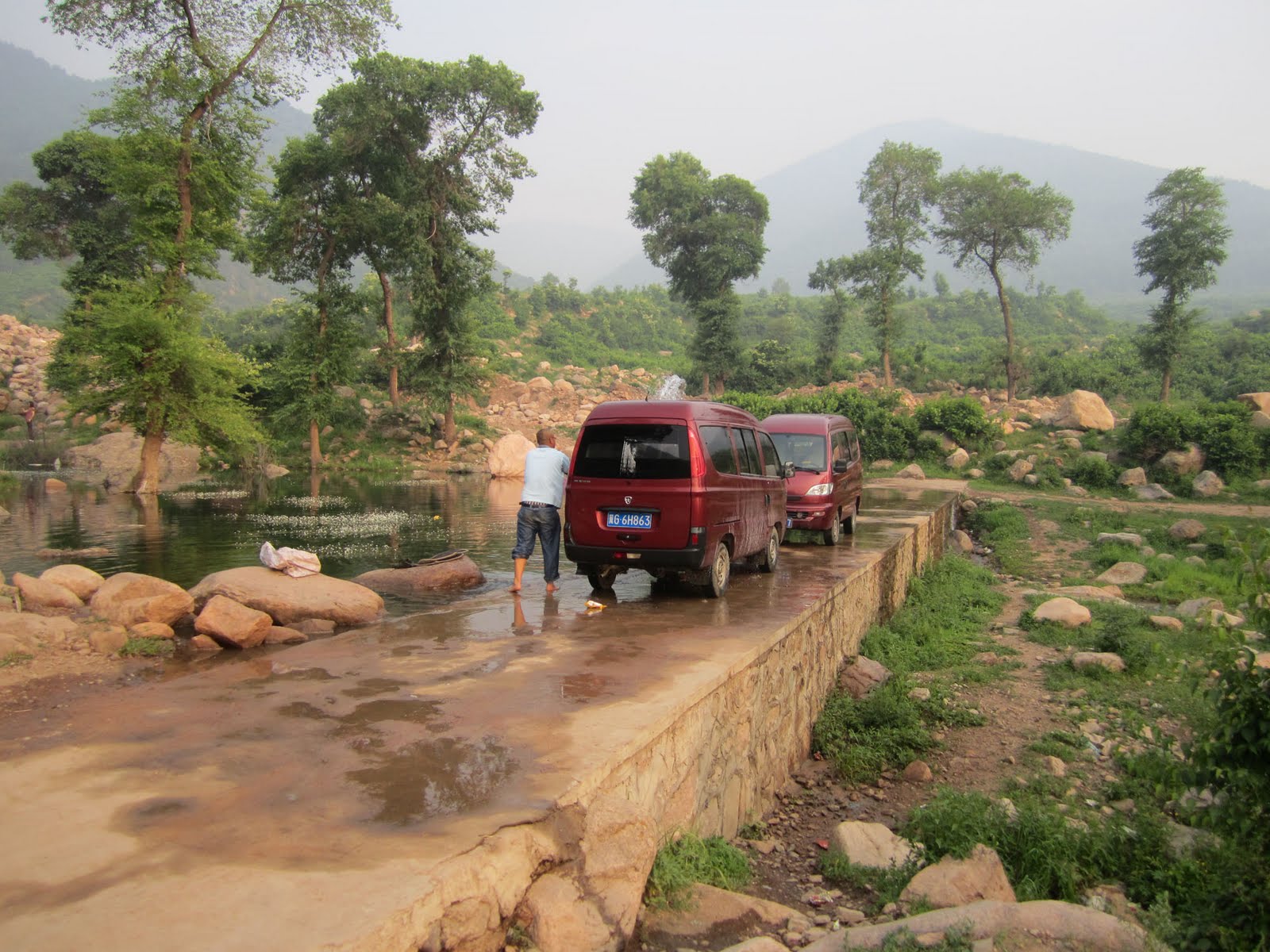
The official trail start is the black tent near the pond. Our driver waited for us in this village, his is the crimson-red van standing away from the two parked face-to-face. Near the van is, coincidentally, the flag-bearing hiking group leader from the mountaintop - the one who was so anxious to get a photo with me.


This pond serves many purposes for the locals. By the time my entire group made it down the mountain, it was perfectly clear that we would not make it back to county center in time to catch the last bus to Beijing. Our driver gunned the engine and we were off to the local train station.


The station may have been located in a rural area, but the train was anything but. As a supply chain major, I like to think that I know a thing or two about steel horses, but this thing was quite a surprise even for me. Cruising at over 120 km/h - a panel indicates speed, outside temperature, and other data - this thing was not only loaded chock-full of technology, but even the bathroom was big enough to stage a World Cup football match. As for headroom and the main alley - well let's just say that I could have probably landed a 747 with engine fire and still had enough room to park a stretch Lexus in there. There was enough legroom to lay yourself flat on the floor in front of your seat. The train was empty, so we commandeered ourselves a train-car and promptly fell off to sleep after dispatching the remainder of our food supply.


The group on our way back to Beijing. The outing was a blast - besides getting to ride in a Chinese bus, car, and train, I got to run up and down a mountain, experience more of the local nature, and friend some great people - all in fresh air.

Tuesday, July 6, 2010

Let's Get Traditional


Friends, you no doubt know that most of the time, yours truly is a veritable wreck. Knees, shoulders, feet - you name it - every part of my body is continually tested to see what it is made of (sorry, Mom). Between the long days of class, work, hardcore physical training, and constant sleep deprivation, something is bound to give. Pushing through aches and pains here and there is standard operating procedure for endurance athletes, but you do hit a real snag every once in a while. Shortly before leaving for China, I burned up some pavement and blew up and down a mountain, leaving a thrashed ligament in my right foot.

Finding myself in China, the birthplace of acupuncture, it would only be fair for me to seek traditional treatment. I'm a firm believer in acupuncture, and have been for quite a long time. Several years ago, I had a serious knee injury from cycling - bruised tendons, torn up ligaments - I could barely walk. For months I tried cortisone shots, physical therapy and constantly fought off doctors who wanted to put on me on the operating table and do some cutting. At 17, I didn't think full-body anesthesia, bright lights and cold steel were what I needed - I knew my body could heal itself. So I searched for "holistic" treatment - the umbrella term for any non-traditional medicine. I was extremely lucky to find Tiru Liang, a Chinese doctor with over 30 years of experience in applying acupuncture. Seeing Tiru twice a week for a month put me back on my feet, and in a few more months, I could run again. I believe that healing is an art, not a science, and Tiru is one of the best practitioners of any art I have ever come across.

With my right foot aching and Tiru several thousand miles away, it was time to get traditional, locally. Several weeks ago I was fortunate enough to meet Josh, an Arizona native who has lived in Beijing for 6 years. Besides knowing all the good restaurants in this city, Josh knows where to go for acupuncture, and would be instrumental in getting me past the Chinese registration (his Mandarin is quite good) and into the hands of a capable physician. On Josh's recommendations, we visited the Guoyitang Institute/Hospital of Traditional Medicine in Chaoyang.


Josh and his fiancee - very soon to be wife - Sunny. I met Josh at a Hutong School dinner several weeks back. He is very well connected and teaches English to many different groups in Beijing including Chinese air force officers, college students planning to study in the U.S, and employees of various embassies around town. He also teaches Mandarin to foreigners such as myself.


The lobby is a fur-ball of activity. Registration on one side, herbs for sale on the other, and locals waiting or scurrying about with paperwork wherever you look.


After Josh and Sunny picked a leg/foot specialist for me to see, we paid the registration fee and headed over to the building next door to see the doctor.


The second entrance was even more elaborate than the first, adorned with intricate decorations such as this Yin and Yang sign. If I had to dream up some interior design, I would make a traditional Chinese medicine hospital look just like this.

Dr. Seng, the physician I saw, turned out to be precisely who I was looking for. Knowledgeable, calm, collected, fast-moving - and English-speaking. As you can guess, I have to compare any acupuncturist's skill to that of Tiru, and this guy was definitely up there. After I explained my problem, I received the requisite-doctor-roll-of-the-eyes from Dr. Seng - doctors always have a hard time understanding why people such as myself like to push the envelope and punish their bodies. I didn't even mention to him that I typically run barefoot. I figured the less he knew, the better for all of us. After some brief examination and prodding of my foot, he proceeded to insert the needles - putting them precisely where I would have wanted them. It is a common misconception that acupuncture is not supposed to hurt, and if it does, it is not done correctly. This is totally wrong - the point of putting needles inside of your body is to accelerate the body's natural healing systems, which may not be focusing on the ailment in question as much as you'd like them to. By inserting needles into the meridians through which "Qi" (the body's energy) flows, you tell your body to "get working on this, NOW". Obviously, if something hurts, it may have to hurt even worse before it gets better - that is acupuncture. So did I feel nice and cozy and dreamed of flowers and unicorns when Dr. Seng stuck me up with needles, hooked up the electrodes, and ramped up the electricity flow between them? If you are masochistic enough to consider sharp pain nice and cozy, then your answer is yes.


There are 4 needles down at my foot, with 2 more positioned on the leg (you can see the one by the right knee, sticking outward). Running electricity between pairs of needles is even more beneficial. The act of acupuncture does not actually heal - it may even damage the tissue further - but the body's reaction will be one of renewed healing, far stronger and faster than it would have been had you simply laid on the couch waiting for the pain to subside. The heating lamp on the right further increases blood-flow to the foot, bringing the macro-nutrients/minerals needed for healing. I would be seeing Dr. Seng three times per week (at 20 min per treatment) until the pain has fully subsided - acupuncture can take time, but it is time the body needs to heal properly - no quick fixes, please.


Just what the doctor ordered: authentic German beer is probably one of the best ways to recover after you've let an acupuncturist try to turn your foot into Swiss cheese with a box of needles. We took ours at the Drei Kronen Brauhaus, a 700 year-old Bavarian brewery by way of new Beijing.


Amid a sea of Bavarian colors, note the Israeli flag - Josh is Jewish - next to the Ukrainian one. Yeah, we drank to continued international cooperation, but not in those lofty words. To peace!

Standard Sergiy Disclaimer: for the overwhelming majority of acupuncture patients, needles are not inserted deep and pain/discomfort is absolutely minimal. The electricity pulsing between needles is adjusted by the doctor at your bequest - he asks you how much juice you want and you let him know if you want a couple turns of the unhappy-face dial. Most people prefer a slight tingle, but I have found that a high level works for me - every pulse brings a vivid sensation of pain throughout the injured region and up the leg. Obviously, I know what works for my body - massive doses of whatever it is we're talking about - but this is not the case for everyone. Don't let this article discourage you from seeking acupuncture treatment: it is a comfortable, more natural, and more permanent fix than popping pain-killers on a daily basis, or worse, submitting to a surgeon. Besides musculo-skeletal issues, it has also been known to cure addictions and mental disorders. Simply put, if you are having problems, find yourself an experienced practitioner and give it a try.

Tuesday, June 29, 2010

Pop Quiz

Lets see if anyone can give me a good answer to the following question. First correct guess will get a special gift from China - leave your answer in the comments section below or email it to me at sergiyzubko@gmail.com before July 6th.

You will notice a rope dangling just outside the window in the below photo. Guess what it is used for. Hints: photo was taken from the 23rd floor of an (upscale) office building, and the answer isn't Spiderman.


Winner, along with explanation, will be announced shortly after July 6th. Kids (of all ages), send me your edumacated guesses!