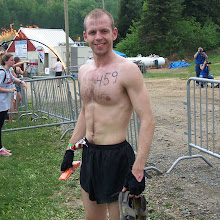
Wednesday, July 7, 2010

Harmony in Haituo

Continuous acupuncture treatments non-withstanding, it was time to get some proper running in, which means clean air and drastic elevation changes. Beijing is ringed by mountains - on good air quality days, I can actually see them from my office window, despite the closest of them being over 30 kilometers away.

The only problem with getting out of Beijing is my acute lack of Mandarin, which inhibits my access to transportation. Unlike the city subway system with its map and clearly laid-out stations, the bus routes around Beijing are too numerous to list and put down on paper, with hundreds of buses going by thousands of different roads – you really have to know where you’re going and which bus to take in order to get to your destination in anything resembling timely fashion (if you get there at all). Not one to be restrained from scaling a (big) pile of rocks, I swung my cursor over to the Beijinger, a popular site for local ex-pats and English-speaking Chinese alike. It didn’t take me long to find Sonia, a Chinese woman with a real penchant for hiking and nature. She gathers groups of Chinese and foreigners for a trip out of the city almost every weekend. Having visited most of the local parks and mountains, Sonia is quite comfortable with traversing greater Beijing. Perfect.

Several peaks in the Beijing area exceed 2000 meters in height. Lingshan mountain is the highest at over 2300 meters, with the top of Haituo (also named Song Shan) coming in around 2,241 – this is the range we would be heading to on this particular outing. Unfortunately, the trail we would take tops out at a peak height of 2198 meters – but it would have to do.

We began by taking a bus out of town. The 2 hour trip turned into 3 as we ran into (you guessed it) a huge column of trucks. The aforementioned truck column has been haunting me on every trip outside of the city. Just when I think I’ll get to breathe something amounting to pristine air, out of nowhere come rows and rows of hulking 18-to-24-to-36-wheelers spouting black smoke into the atmosphere and making me hate life. On the plus side, we drove by various sections of the Great Wall – my first sighting of this wonder of the world. After maneuvering our way through the truck formation and past the Wall, we finally arrived at a small city - Yanqing county center. From here we would have to rent a car to take us to the trailhead. For 260 kuai, the driver would take us the 60 kilometers up into the mountains, wait for us to complete the hike, and bring us back again – not a bad deal when split between 8 people.


The Great Wall snaked along ridge-lines we drove under.


The 60 kilometer drive from county center to trail-head was done over some of the roughest terrain I've ever traversed in a car. Besides being made almost entirely out of rocks, the road meandered through serpentine switchbacks as it rose and fell over the Haituos. I seriously doubt this sort of thing would be attempted with anything less than all-terrain tires and 8 cylinders back in the States, but our van was equipped with lawnmower-thin tires, powered by 4 tiny cylinders, and loaded down with 8 (fat/happy) passengers plus driver. Result - our kidneys felt every tiny bump in the road, jolting us up, down, sideways, and into each other as the driver fought the road each second of the way. If I didn't spend the majority of my time shielding the camera from direct impact with someone's elbow/knee/face/walking stick, I would have filmed a little video clip of this ride-from-hell. Some of those downhill runs were truly epic - I swear at one point the window next to me almost cracked when the driver pretended to be a pilot and landed the van in a hole three seconds after getting it airborne.


Haituo! The beauty of this place is difficult to describe. From where I stood to take this photo, we would climb to the furthest/highest peak seen over the horizon. The trip takes an average of 2-3 hours one way, starting with flats and then turning sharply up and over several smaller peaks before reaching the top. As agreed, at this point I left my group and began running up the trail. I would go all the way to the top before turning around and meeting them somewhere during their climb up.


First time at the top. This mountain/trail is very popular with the Chinese but rarely sees any foreigners. The entire way up, Chinese hikers were downright stunned to see me, instantly producing cameras and smiling for me to get a picture taken with them - despite hearing about this in America and after arriving, this is the first time I experienced this sort of treatment. A hiking group was resting on the peak when I ran up there - before I realized what's going on, the leader hailed me down, handed me one end of a flag to hold, and pointed my face into his photographer's camera - oh yeah, instant celebrity. In return, he got to take a photo of me with the plaque denoting mountain name and elevation.


The air was amazing at this altitude, I couldn't get enough of it. While it was around 35 degrees and sunny down in the valley, it couldn't have been more than 18-20 degrees up here, with a fine mist covering the mountaintop. The air was filled with buzzing - note the bees - even at this altitude there are lots of flowers growing in the meadow for them to harvest nectar from.


The white, yinlianhua(银莲花) and yellow jinlianhua(金莲花), flowers only grow at altitudes of over 2000 meters. We were very fortunate to find some.


Second time at the top. After running to the peak and taking lots of pictures coming back down, I ran into my group - they were about halfway up the trail. They were at the most brutal part, where the path begins to move steeply up for over a mile. With the afternoon sun raging and her backpack loaded down, Sonia was really struggling. After grabbing her pack and offering her (personal trainer style) encouragement, we continued moving up the mountain. Eventually, we made it to the top - by this time the sun had burned off most of the mist, so we were rewarded with beautiful views in all directions.


By this time the entire group was starving. Now, I like to pack high-energy, low-weight food such as dried fruit and nuts when traveling over land, so much the better to fuel me but keep the weight down. My fellow hikers however, had other notions, finally revealing what they were carrying in their bulging packs. To my surprise (and delight) lunch consisted of everything from fresh (tomatoes, cucumbers) to pickled (cabbage, peppers) vegetables to dumplings filled with meat and mushrooms. Chocolate, cookies, and fruit rounded out the spread. On second thought, I shouldn't be surprised it took them so long to get up the mountain.


Flowers lined our entire path, up and down the mountain.


A clear stream ran down the mountainside - it was very cold to the touch. It would have been great to splash the guy napping in the trees, especially for brushing up on my Mandarin curse words.


More flowers, though I can't name these.


Horses were chomping on grass all around the valley.


The official trail start is the black tent near the pond. Our driver waited for us in this village, his is the crimson-red van standing away from the two parked face-to-face. Near the van is, coincidentally, the flag-bearing hiking group leader from the mountaintop - the one who was so anxious to get a photo with me.

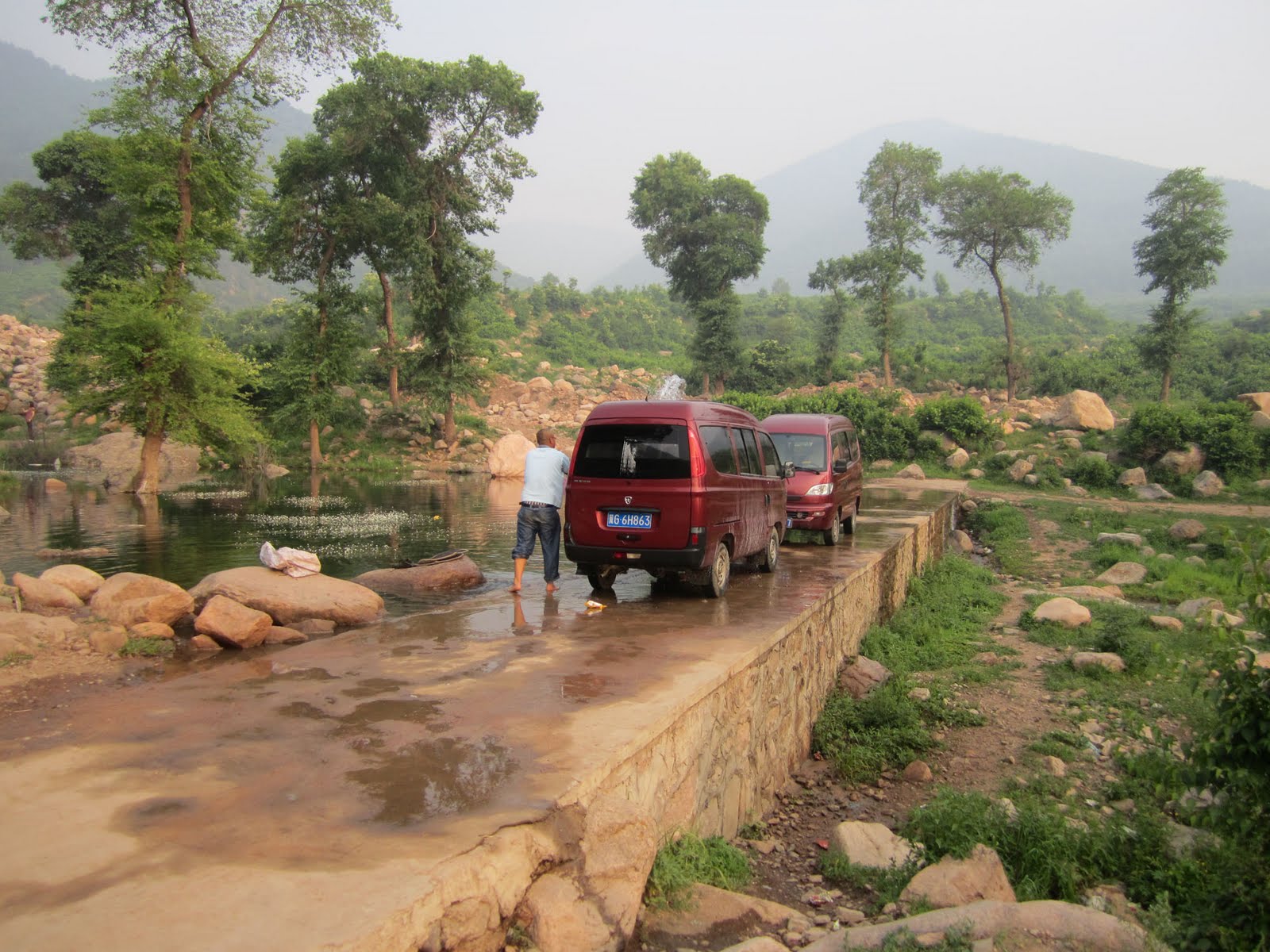

This pond serves many purposes for the locals. By the time my entire group made it down the mountain, it was perfectly clear that we would not make it back to county center in time to catch the last bus to Beijing. Our driver gunned the engine and we were off to the local train station.


The station may have been located in a rural area, but the train was anything but. As a supply chain major, I like to think that I know a thing or two about steel horses, but this thing was quite a surprise even for me. Cruising at over 120 km/h - a panel indicates speed, outside temperature, and other data - this thing was not only loaded chock-full of technology, but even the bathroom was big enough to stage a World Cup football match. As for headroom and the main alley - well let's just say that I could have probably landed a 747 with engine fire and still had enough room to park a stretch Lexus in there. There was enough legroom to lay yourself flat on the floor in front of your seat. The train was empty, so we commandeered ourselves a train-car and promptly fell off to sleep after dispatching the remainder of our food supply.


The group on our way back to Beijing. The outing was a blast - besides getting to ride in a Chinese bus, car, and train, I got to run up and down a mountain, experience more of the local nature, and friend some great people - all in fresh air.

...and the Winner of our first Pop Quiz - a Draw!

Gang, I would like to announce the winner of last week's Pop Quiz and give you the visual answer to my question. The contest was heated, with many of you sending in correct guesses, which means the prize will go to he or she who replies first. Problem - the first two correct guesses were sent in at the exact same time.

Here is a breakdown of guesses and (Beijing) date/time they were received:

Mama - June 29 1:50am: "evacuation rope" (great idea Mom, I'll be sure to try it sometime)
Mama - June 29 1:53am: "support rope for window cleaning people's platform"
Lissa - June 29 1:53am: "I am pretty sure it's for men who clean the windows, right? I mean, it's not like 23rd floor is really high, but if its an office building, they probably have lots of those long windows that you can't really clean with your hand sticking from inside out." (Analytic, isn't she?)
Vitia M - June 29 4:53am "rope is a coaxial cable transporting tv signal" (winner of Smartest-Answer-to-my-Dumb-Question award)
Carl - June 30 11:08am: "Window cleaning?"
Angela's Mom - July 3 12:27pm: "the rope outside your window is attached to a hook and harness which is buckled on to a window cleaner" (all technicalities considered, probably the most correct guess)

The answer:


Okay, okay, I see you out there, you're dubious, you will attempt to use your superior logic and argue with me that only Lissa should get the award - after all, the cleaning people did not use a "platform" per se, so Mom shouldn't be considered a winner. Well, naysayer, since Mom did not sufficiently clarify the precise definition of the term "platform", we can call the harness around the window-washer's body a platform - a "platform" to which a support rope is attached, with combination of the above intended to be used as a device providing safety to individuals cleaning windows in high-rise office buildings.

Pop Quiz Winners: Mom, Lissa. Winners will receive unique gifts (TBD) from China.
Honorary Winner: Vitia M, for providing a great guess as to the nature of the rope. Vitia will receive a Chinese-designed, Chinese-built TV set circa 1955 (rope antennae standard) for his troubles. Just kidding, but Vitia will get a cool gift nonetheless - so send me interesting answers next time around.

Stay tuned for more quizzes!

Tuesday, July 6, 2010

Let's Get Traditional


Friends, you no doubt know that most of the time, yours truly is a veritable wreck. Knees, shoulders, feet - you name it - every part of my body is continually tested to see what it is made of (sorry, Mom). Between the long days of class, work, hardcore physical training, and constant sleep deprivation, something is bound to give. Pushing through aches and pains here and there is standard operating procedure for endurance athletes, but you do hit a real snag every once in a while. Shortly before leaving for China, I burned up some pavement and blew up and down a mountain, leaving a thrashed ligament in my right foot.

Finding myself in China, the birthplace of acupuncture, it would only be fair for me to seek traditional treatment. I'm a firm believer in acupuncture, and have been for quite a long time. Several years ago, I had a serious knee injury from cycling - bruised tendons, torn up ligaments - I could barely walk. For months I tried cortisone shots, physical therapy and constantly fought off doctors who wanted to put on me on the operating table and do some cutting. At 17, I didn't think full-body anesthesia, bright lights and cold steel were what I needed - I knew my body could heal itself. So I searched for "holistic" treatment - the umbrella term for any non-traditional medicine. I was extremely lucky to find Tiru Liang, a Chinese doctor with over 30 years of experience in applying acupuncture. Seeing Tiru twice a week for a month put me back on my feet, and in a few more months, I could run again. I believe that healing is an art, not a science, and Tiru is one of the best practitioners of any art I have ever come across.

With my right foot aching and Tiru several thousand miles away, it was time to get traditional, locally. Several weeks ago I was fortunate enough to meet Josh, an Arizona native who has lived in Beijing for 6 years. Besides knowing all the good restaurants in this city, Josh knows where to go for acupuncture, and would be instrumental in getting me past the Chinese registration (his Mandarin is quite good) and into the hands of a capable physician. On Josh's recommendations, we visited the Guoyitang Institute/Hospital of Traditional Medicine in Chaoyang.


Josh and his fiancee - very soon to be wife - Sunny. I met Josh at a Hutong School dinner several weeks back. He is very well connected and teaches English to many different groups in Beijing including Chinese air force officers, college students planning to study in the U.S, and employees of various embassies around town. He also teaches Mandarin to foreigners such as myself.


The lobby is a fur-ball of activity. Registration on one side, herbs for sale on the other, and locals waiting or scurrying about with paperwork wherever you look.


After Josh and Sunny picked a leg/foot specialist for me to see, we paid the registration fee and headed over to the building next door to see the doctor.


The second entrance was even more elaborate than the first, adorned with intricate decorations such as this Yin and Yang sign. If I had to dream up some interior design, I would make a traditional Chinese medicine hospital look just like this.

Dr. Seng, the physician I saw, turned out to be precisely who I was looking for. Knowledgeable, calm, collected, fast-moving - and English-speaking. As you can guess, I have to compare any acupuncturist's skill to that of Tiru, and this guy was definitely up there. After I explained my problem, I received the requisite-doctor-roll-of-the-eyes from Dr. Seng - doctors always have a hard time understanding why people such as myself like to push the envelope and punish their bodies. I didn't even mention to him that I typically run barefoot. I figured the less he knew, the better for all of us. After some brief examination and prodding of my foot, he proceeded to insert the needles - putting them precisely where I would have wanted them. It is a common misconception that acupuncture is not supposed to hurt, and if it does, it is not done correctly. This is totally wrong - the point of putting needles inside of your body is to accelerate the body's natural healing systems, which may not be focusing on the ailment in question as much as you'd like them to. By inserting needles into the meridians through which "Qi" (the body's energy) flows, you tell your body to "get working on this, NOW". Obviously, if something hurts, it may have to hurt even worse before it gets better - that is acupuncture. So did I feel nice and cozy and dreamed of flowers and unicorns when Dr. Seng stuck me up with needles, hooked up the electrodes, and ramped up the electricity flow between them? If you are masochistic enough to consider sharp pain nice and cozy, then your answer is yes.


There are 4 needles down at my foot, with 2 more positioned on the leg (you can see the one by the right knee, sticking outward). Running electricity between pairs of needles is even more beneficial. The act of acupuncture does not actually heal - it may even damage the tissue further - but the body's reaction will be one of renewed healing, far stronger and faster than it would have been had you simply laid on the couch waiting for the pain to subside. The heating lamp on the right further increases blood-flow to the foot, bringing the macro-nutrients/minerals needed for healing. I would be seeing Dr. Seng three times per week (at 20 min per treatment) until the pain has fully subsided - acupuncture can take time, but it is time the body needs to heal properly - no quick fixes, please.


Just what the doctor ordered: authentic German beer is probably one of the best ways to recover after you've let an acupuncturist try to turn your foot into Swiss cheese with a box of needles. We took ours at the Drei Kronen Brauhaus, a 700 year-old Bavarian brewery by way of new Beijing.


Amid a sea of Bavarian colors, note the Israeli flag - Josh is Jewish - next to the Ukrainian one. Yeah, we drank to continued international cooperation, but not in those lofty words. To peace!

Standard Sergiy Disclaimer: for the overwhelming majority of acupuncture patients, needles are not inserted deep and pain/discomfort is absolutely minimal. The electricity pulsing between needles is adjusted by the doctor at your bequest - he asks you how much juice you want and you let him know if you want a couple turns of the unhappy-face dial. Most people prefer a slight tingle, but I have found that a high level works for me - every pulse brings a vivid sensation of pain throughout the injured region and up the leg. Obviously, I know what works for my body - massive doses of whatever it is we're talking about - but this is not the case for everyone. Don't let this article discourage you from seeking acupuncture treatment: it is a comfortable, more natural, and more permanent fix than popping pain-killers on a daily basis, or worse, submitting to a surgeon. Besides musculo-skeletal issues, it has also been known to cure addictions and mental disorders. Simply put, if you are having problems, find yourself an experienced practitioner and give it a try.

Friday, July 2, 2010

The Golden Gates of Lawyerism: Part 2 - Spend It

Let it not be said that Chinese lawyers don't know how to spend their hard earned cash and have fun doing it. GoldenGate recently won a Rising Law Firm of the Year award from Asian Legal Business, an Asian (what else?) law magazine. To celebrate, the office headed out to KTV - karaoke for the rest of us. Now, because of its immense popularity in this part of the world, KTV deserves its own post or two, but this will have to do for now. The Chinese take their KTV seriously. When we walked into this place, the reception area (and reception line of women) instantly made me wonder if this particular KTV was part of a 5-star hotel or casino - but nope, all the pomp and splendor was there simply for KTV's sake.


Does this look like your average karaoke lounge entrance back home?


The process is simple: 1) Get private room for your group. 2) Order drinks. 3) Pick songs using computers/TVs and sing. 4) Repeat points 2 and 3 until you're blue in the face. We were lucky - our KTV included a complimentary buffet dinner and some superb service. Before you finished saying "Heineken", the beer was on the table in front of you with the top off. We ordered individual drinks and champagne for the group - the bubbly was of a local Beijing variety but proved to be sweet and delicious - a real treat. Tim, Jack, and I leaned heavily on that bottle.


These guys were super efficient - some of the best service I've seen around Beijing so far.


Just in case things get out of hand, we want to be double-insured.


You can pick your songs from touch-screen monitors around the room. Here Tim and Annie choose their songs - the video then plays on the big screen while surround sound floods the room.


Please believe me when I say Chinese people can't get enough KTV. Some of the paralegals before the IP department got there.


Tim, the founder and managing partner of GoldenGate, and I. Tim has an advanced law degree (LLM - Master of Laws) from American University in DC and is one clever, thorough, and collected lawyer with tons of experience in and out of the courtroom.


"This love has taken its toll on me..."


The local bubbly - I guess we can't officially call it champagne for legal reasons.


"Sometimes you just have to... let it burn"


Linda is the firm's second partner and is directly in charge of the intellectual property department. She's fabulous - smart and beautiful, the sort of woman who instantly commands a room upon walking in. Her and Tim used to work for Lehman (another influential law firm) before striking out on their own and founding GoldenGate.


We may not be able to sing all that well, but that won't stop Jack and I from founding our law firm once he gets his LLM and I get my JD. World, here we come!


About a third of our office eventually made it in.


The complimentary post-KTV buffet was delicious and diverse - here Jack is waiting for his sushi order to be made.


Mixing the wasabi with soy sauce.


My first KTV experience made for a great night in Beijing. There are definitely worse ways to spend company resources!

Thursday, July 1, 2010

The Golden Gates of Lawyerism: Part 1 - Make It

Gang, you may have heard that I’m not sitting around Beijing twitting my thumbs, warming a seat on the couch, or consuming the fume-filled air just for the hell of it. To wit, it has been midterms-like hectic around here for the past few weeks, with most of the pandemonium centered around my internship. I applied for this position before arriving in China, and interviewed a few days after getting here. I guess my FOB-culture-shocked-Ukrainian-American vibe did not throw the managing partner off completely, as I started work the next morning.


The Spaces International Center, north-western edge of the Central Business District and home to the GoldenGate law firm.


GoldenGate is a Chinese boutique law firm based in Beijing. It specializes (hence boutique) in arbitration & litigation, intellectual property rights, as well as general commercial practice and competes with bigger firms on expertise alone – at only 30 people or so (4 partners, 8 associates, the rest paralegals/assistants), we don’t have the manpower to issue IPOs for major corporations, but we can solve a business dispute and get you your money back as easily as the top dogs, and for a whole lot cheaper.

Arbiwhat, you say? How exactly does GoldenGate get your money back? Let me give you an example, as well as warn you ahead of time: this case is, of course, entirely make-belief.


Entrance to the office - the Golden Gates themselves.


Lets pretend you are a heavy equipment manufacturer from an imaginary country we’ll call England. Because China produces gargantuan amounts of this strange, nonexistent substance we will call steel to sell on the global market, you know you can come here to get a good price. So you contract with a fictitious Chinese state-owned business to sell you, oh say, 10,000 tons of steel. You agree to pay the price, the seller agrees to ship the goods when you fork over a couple million bucks, and both of you sign a contract that includes an arbitration clause that states “If either of us decides to act selfish and screw the other party, we will have the following court ______ (insert Chinese/British/other court) settle our dispute.” You wire the money to some unnamed Macao bank account, and sit down to wait for your shipload of steel. Lo and behold! The money disappears, and instead of 10,000 tons of steel, the ship docks with a grand total of 2,000 tons of low quality, no-use-to-anyone-but-the-scrap-yard metal. You scream bloody murder. You call the Chinese company and use unprintable language in your attempt to remedy the situation (you can guess what kind of results that will get ya – that’s right, a big fat zero). You cry on your mommy’s shoulder and shed rivers of tears over your lost millions of dollars. But then, there is a light at the end of the tunnel (its actually your wife who turned on the reading lamp and is telling you your legal counsel is on the line) which lets you realize that the binding contract both firms signed is still in full effect. You jump up and down for joy as you tell your in-house lawyer to find some hardcore badasses to drag the Chinese firm into arbitration court and give ‘em a good spankin’ (and get your money back!).


Reception area laid out in wood.


Arbitration court is a little different from criminal court. No one died because your business deal went sour (okay, I know you wish someone did) so a criminal court just won’t do – what you need is an authority who will listen to both parties and decide who owes whom how much, and what should be done to right the matter. Both of you picked the deciding authority when signing the contract. Let’s just pretend that the purely fictitious organization judging you in this case is called CIETAC, or the China International Economic and Trade Arbitration Commission.

You begin searching for a law firm with a proven track record of success before CIETAC, after all, it is a Chinese organization and the only two things your lawyer knows about China is that the Olympics were once held there and his law school roommate dated a girl from Beijing in his first year. She might have made good Peking duck, but its still not a whole lot to work with. So your lawyer gets on the horn, and asks around for the best guys in the business – and the name GoldenGate may just turn up. You call GoldenGate, and for a small fee (there’s an understatement) the knights in shining armor (at least that’s how you think of them) go to work getting back what’s yours.

The process begins with GoldenGate sending a flowering letter to the Chinese steel manufacturer - said letter is principally centered around the notion of “give back the money, or deliver the steel, otherwise we will kick you so hard in the ass, you’ll be brushing your teeth with our Ferragamos’ shoelaces.” As is not at all surprising by this point in the game, the Chinese firm sends the equivalent of a “screw you” in reply. At this point, the only option left is to resort to CIETAC for arbitration – a rendering of judgment after both parties state their case.


My place of work - it has gotten a lot more cluttered than this - the work keeps piling up.


Before a court panel convenes, the folks at GoldenGate review all facts, evidence, do some speculating, and begin digging – followed by lots and lots of digging. What do they find? A Pandora’s Box worth of fraud, deceit, and downright thievery. Turns out the state-owned company you signed a sales contract with exists in little more than paper form – the address given leads you to an old, broken down warehouse in a rural province. Hold on, you say, they delivered some steel – maybe not all, but it had to come from a plant somewhere, right? Indeed, and after rolling their sleeves up even further, GoldenGate lawyers find out exactly where from. Turns out that state-owned assets (as in owned by the Party and the People) such as mills, smelters and furnaces were “sold” to a private organization in the same province for the outrageously steep price of 10 kuai. Folks, that’s not even enough to get something decent off the McDonald’s dollar menu, yet here we are talking about heavy industry and the assorted manufacturing equipment to go with it. These were the guys who were supposed to supply your steel.

You, with GoldenGate at the helm, have two major problems to deal with:

Problem 1: You signed a contract with what’s called a “shell corporation”, also known as “business vehicle”, instead of the real manufacturer. The entity exists on paper but is entirely controlled by others – and used as a shield when problems arise – because when you say “give me my money or I will take what assets you have” there is not a whole lot to take – remember that warehouse with tiles falling off its sides? Yep, that’s a problem when you’ve been swindled to the tune of several million greenbacks.

Problem 2: You do not have a contract (hence no arbitration clause) with the private organization that actually supplies the steel. This is where it gets tricky – not only do you want to bring the baddies to justice, but you want to get your money back!


I work closely with Jack (he does sit right behind me, after all) on most matters. He has a Bachelor's in mechanical engineering and a law degree from Beijing university - the Chinese equivalent of Yale. Since we sit back-to-back and both like to type furiously, sometimes the whole office is drowned out in the tapping noise - I call this smoking keyboards.


Solution: armed with this new (not to mention explosive) information, GoldenGate goes to CIETAC and initiates the process of turning a far-away province upside-down. After discovering who sold state assets (company executives), who covered up the sale (local government), and who let it all slide (government auditors), you begin to get closer to justice. However, everyone involved in the litigation wants a piece of blubber from the drowning whale – the People want their assets back, the government wants a fat cut, and all the way down the totem pole comes the foreign client who got screwed – you! After much meddling and peddling on behalf of GoldenGate to raise your totem-pole standing, you finally get your beloved money back. The process is not quick – a year’s time is considered lightening speed in arbitration – but GoldenGate gets the job done.

See, I told you this sort of thing could never happen. I also have a nice piece of beachfront property to sell you – it is located in downtown Beijing, China.

Though I am the only foreigner at the firm, our clients are almost exclusively international – those who do or wish to do business in China. Coincidentally, that is also the origin of our name (it has nothing to do with the Golden Gate Bridge in San Fran, sorry guys) – simply put, we are your Gate to conducting business in China. Gold is also an important part of Chinese tradition – it represents royalty and importance, among other meanings.

Besides arbitration, GoldenGate also handles intellectual property matters – someone steals your company name, website layout, or product design and you’re out for blood – as well as general commercial work, such as making sure that no gross legal violations occur when a foreign company is conducting business in China. This is how we make money.


My first official business cards - its always nice to belong to something. Out of the 500 I received in the first pack, over 350 are already gone. That's right, networking is a way of life in this city.


What do I do, you ask? Mostly what I’m doing now – writing! I draft English letters dealing with day-to-day business and polish translations. All of our partners and lawyers speak good English, but their writing often needs one final shine before being sent to a client. This work is very interesting and highly educational – not only am I handed a document and asked to polish it, but I am given a good explanation of the case (along with access to the entire file) so that I actually know what’s going on. This is very important – not only am I looking for grammatical errors to fix, but the writing must make sense. As a result, I’ve learned to not only tolerate legalese (gasp!) but actually read it for deeper understanding. Some of my time is also spent on legal research – much like in the West, the Chinese legal system uses precedent, so I often read through past cases to try and find one creative way or another to pin some dirtbag to a wall – basic lawyer work. My workflow process goes something like this: Tim, our managing partner will toss Jack (associate) and myself a piece of work – such as a case. Jack and I will conduct research, with Jack then drafting the Chinese documents. Tim will review these, with Jack correcting and translating the files into English before sending them over to me for proofreading. After we run through this circle, the files get sent out to pertinent parties. Every once in a while a court attendance is in order. I also get a "stipend" to attend events all over the city and fly the GoldenGate flag - the promotion part of my job. More on this later.


A photographer came in to take photos for the website. I guess he was unused to shooting Westerners because he couldn't find the perfect place to take pics of me. What resulted was a 20 min pro-level photo-shoot-scramble around the office with me posing, the paralegals giggling, and everyone having a great time. In the second photo, Beijing is laid out below me.